



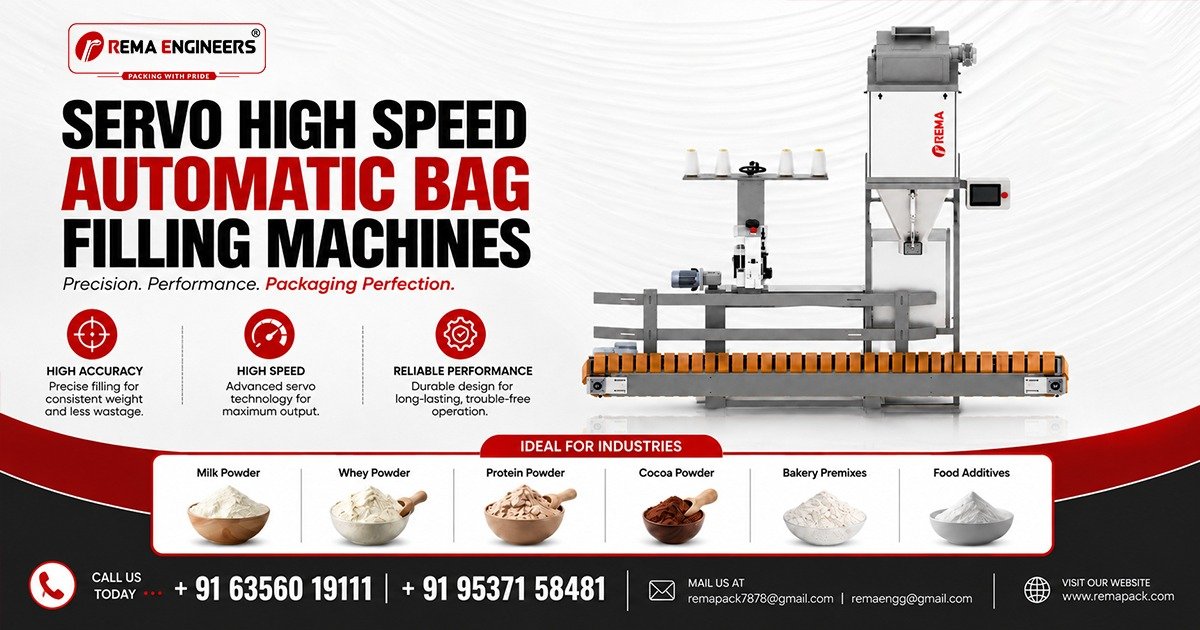
Bulk packaging becomes difficult when bag weights, material flow, and operator handling must remain consistent across repeated production cycles. Rema Engineers Pvt. Ltd. Pvt. Ltd. supports these requirements from Ahmedabad, Gujarat, India.
Where Automated Bag Filling Fits Into the Packaging Line
A servo-controlled bag filling machine is used to automate the filling of bags with free-flowing materials. Rema Engineers Pvt. Ltd. identifies plastic granules and similar materials as suitable applications, with a stated bagging range of 5 kg to 50 kg.
For a plant, the machine can sit between material feeding and final bag handling or sealing. The actual arrangement depends on the product, bag format, production target, and available floor space.
Automation can be particularly useful where repetitive manual weighing and filling create inconsistent cycle times or unnecessary operator involvement.
What Buyers Should Define Before Selecting the Machine
Before requesting a quotation, buyers should define:
- Bag weight: Confirm the normal and maximum filling range required.
- Material: Provide details about granules, polymers, chemicals, or other free-flowing products.
- Production target: Establish the required bags per minute rather than selecting equipment only by nominal speed.
- Bag characteristics: Discuss bag dimensions, construction, opening arrangement, and handling requirements.
- Available space: Check machine footprint and access for operators and maintenance.
- Automation level: Decide which filling, weighing, bag handling, and sealing stages need automation.
- Plant utilities: Confirm electrical and other utility requirements with the supplier.
- Future demand: Consider whether the selected configuration can accommodate expected production changes.
Rema Engineers Pvt. Ltd. currently lists 5–50 kg as the weight range and 3–10 bags per minute as the stated speed range for this machine category. Actual performance should be confirmed against the specific material and project configuration.
How the Filling Cycle Can Be Structured
A typical automated sequence can involve:
Material Feeding
The product is supplied to the filling system from the plant’s material-handling arrangement.
Weighing and Dosing
The required quantity is measured according to the selected filling setting.
Bag Filling
The measured material is transferred into the positioned bag.
Bag Discharge
Once filling is completed, the filled bag moves to the next handling or sealing stage.
Final Packaging
The completed bag can proceed to downstream operations according to the plant layout.
Site Planning Matters Before the Machine Arrives
Installation planning should start before dispatch. A suitable location needs enough room not only for the machine but also for material loading, bag placement, operator movement, inspection, and maintenance.
Check these points during project planning:
- Verify the available floor area and machine access route.
- Confirm the electrical supply and connection requirements.
- Keep the material input path clear.
- Provide sufficient space around service-access areas.
- Coordinate the machine with upstream feeding and downstream packaging equipment.
- Plan safe operator movement around the working zone.
- Complete trial operation and commissioning before regular production.
Keeping Filling Performance Stable During Production
Routine maintenance should focus on cleanliness, moving assemblies, weighing-related components, electrical connections, fasteners, and areas exposed to product accumulation.
A practical maintenance approach includes:
- Clean material-contact and working areas regularly.
- Inspect moving parts for abnormal wear or looseness.
- Check electrical connections during planned servicing.
- Inspect weighing and filling components for contamination or obstruction.
- Monitor unusual vibration or noise.
- Keep commonly required replacement parts available where practical.
- Follow the manufacturer’s recommended service procedure and maintenance schedule.
Operators should also record recurring filling deviations instead of repeatedly adjusting settings without identifying the underlying cause.
Troubleshooting Guide
| Issue | Possible Cause | Practical Check |
| Inconsistent bag weight | Material flow or setting variation | Check product flow and configured filling parameters |
| Reduced filling rate | Feeding interruption or operating variation | Inspect material supply and machine settings |
| Irregular machine movement | Loose or worn component | Stop the equipment safely and inspect the relevant assembly |
| Material accumulation | Product buildup around working areas | Clean the affected area according to the operating procedure |
| Repeated filling variation | Product characteristics or process changes | Review material consistency and operating conditions |
What to Verify Before Placing a Purchase Order
Ask the supplier to clarify:
- Confirmed filling-weight range
- Expected operating speed for the actual product
- Material compatibility
- Bag dimensions and format
- Automation sequence
- Machine footprint and layout
- Electrical and utility requirements
- Testing procedure before dispatch
- Operating and maintenance documentation
- Spare-part availability
- Installation and commissioning assistance
- Training and technical support
- Customization requirements, if applicable
Services
- Requirement assessment based on material, bag weight, and production target
- Machine configuration and packaging-line planning
- Installation and commissioning coordination
- Technical assistance and after-sales support
Location
For U.S. packaging plants, sourcing equipment internationally requires attention to machine configuration, shipping preparation, documentation, installation planning, and technical communication. Servo High Speed Automatic Bag Filling Machines in United States requirements can therefore be evaluated around the actual plant process rather than location alone. Relevant industrial and commercial centres include Chicago, Houston, Los Angeles, New York City, Atlanta, Dallas, Detroit, Phoenix, Philadelphia, Columbus, Indianapolis, Charlotte, Nashville, Memphis, Cleveland, Cincinnati, Milwaukee, Minneapolis, Pittsburgh, St. Louis, Kansas City, Denver, Seattle, Portland, and San Francisco.
Planning U.S. Packaging Requirements With Rema Engineers Pvt. Ltd.
Rema Engineers Pvt. Ltd. Pvt. Ltd. manufactures and supplies packaging machinery from Ahmedabad, Gujarat, India, and lists servo high-speed automatic bag filling machines within its product range. Its website also identifies applications across areas including plastics, chemicals, foods and FMCG, agriculture, and industrial packaging.
For Servo High Speed Automatic Bag Filling Machines in United States, buyers can discuss the material, bag range, output requirement, plant layout, and automation expectations with the company before finalizing a configuration.
Rema Engineers Pvt. Ltd. Pvt. Ltd.
The company states that its manufacturing unit is based in Ahmedabad, Gujarat, India, with factory units in Odhav and Vatva, Ahmedabad.
FAQs
Q: What bag weights can these machines handle?
A: Rema Engineers Pvt. Ltd. lists a 5 kg to 50 kg weight range. The appropriate configuration should be confirmed according to the material and required bag size.
Q: What speed is listed for the machine?
A: Rema Engineers Pvt. Ltd. states a speed range of 3–10 bags per minute. Actual output can depend on product, bag weight, and operating conditions.
Q: What should a U.S. buyer discuss before ordering?
A: Confirm bag specifications, material behavior, required output, machine layout, utilities, documentation, installation responsibilities, spare parts, and technical support before purchase.
Conclusion
For bulk packaging operations, consistent filling depends on suitable material handling, correct weight selection, machine configuration, and controlled operation. Buyers in the United States should evaluate these factors before ordering. Rema Engineers Pvt. Ltd. can discuss Servo High Speed Automatic Bag Filling Machines in United States requirements with manufacturing support from Ahmedabad, Gujarat, India.
Call Us: +91-63560-19111 +91-95371-58481
Email: remapack7878@gmail.com | remaengg@gmail.com
Website: www.remapack.com
View Product: Click here