



Food processors and packaged-food manufacturers need tray packaging that matches the product, film, production workflow, and available plant conditions. This article explains how to evaluate a Rotary MAP (Vacuum+Gas) Tray Sealing Machine In Bihar before moving from enquiry to installation.
Start With the Product, Not the Machine
The first purchasing mistake is often choosing a tray sealing machine before defining what the packaging process actually needs.
A buyer should begin with the product being packed and then work backward toward the machine configuration. Product characteristics, tray dimensions, sealing film, desired atmosphere, production volume, and operator involvement can all affect the appropriate setup.
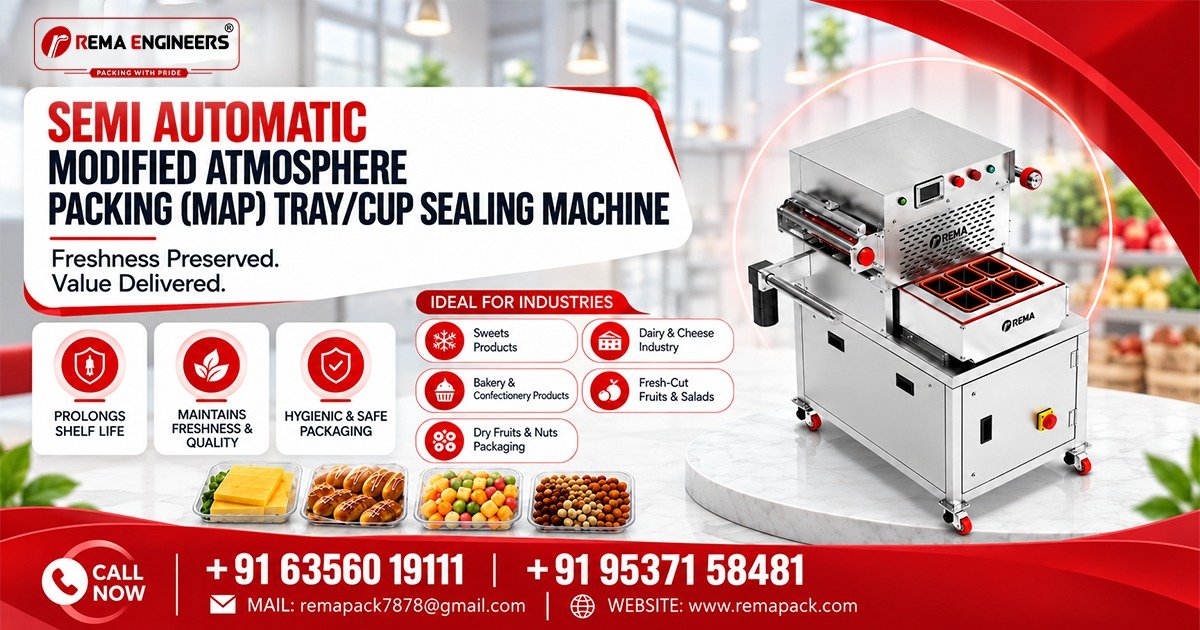
For products where air removal and controlled gas replacement are part of the packaging process, MAP equipment can combine several operations within the tray-sealing cycle.
A practical requirement sheet should include:
- Product type and physical characteristics
- Tray length, width, and height
- Number of trays handled in each cycle
- Required production volume
- Tray and lidding-film material
- Whether vacuum and gas flushing are required
- Available electrical supply
- Compressed-air availability, where applicable
- Available floor space
- Preferred automation level
- Cleaning and maintenance access
This information gives a manufacturer a much clearer basis for recommending a machine configuration.
What Actually Happens During a Vacuum-and-Gas Tray Sealing Cycle?
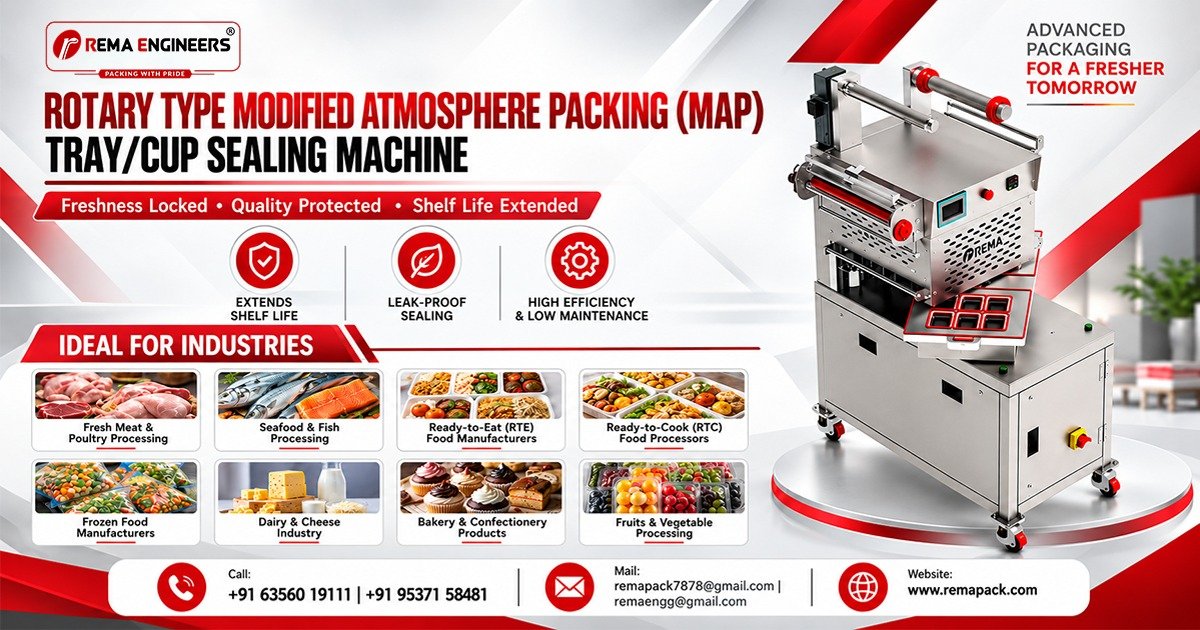
A Rotary MAP system generally brings vacuum evacuation, gas flushing, heat sealing, and film cutting into a defined packaging sequence. Rema Engineers Pvt. Ltd. describes its rotary MAP equipment as a system for tray/cup sealing using vacuum and gas technology.
A simplified operating sequence is:
- The filled tray is loaded into the machine mould.
- The tray enters the sealing chamber or station.
- Air is evacuated according to the selected process.
- The required gas atmosphere is introduced.
- Lidding film is sealed onto the tray.
- The film is cut and the finished pack is removed.
The important point for buyers is that MAP is not simply a sealing operation. The vacuum, gas, tray, film, product, and sealing process need to work together.
The actual gas composition and process settings should be established according to the product and packaging requirements rather than assumed from the machine name alone.
Which Machine Details Should Be Confirmed Before You Request a Quote?
For a buyer comparing packaging equipment, the most useful questions are often configuration questions rather than headline performance claims.
Ask the manufacturer to confirm:
- Whether the required tray dimensions can be accommodated
- Whether the required tray mould is available or can be configured
- Whether the machine performs vacuum, gas flushing, sealing, and cutting as required
- What film dimensions and film types are compatible
- How tray loading and unloading will fit the production process
- What automation level is appropriate
- What electrical and compressed-air requirements apply
- How cleaning access is arranged
- Which components require routine inspection or replacement
- What documentation and operating information will be supplied
Rema Engineers Pvt. Ltd.’ published rotary semi-automatic model information identifies vacuum, gas flushing, sealing, and cutting as machine operations and notes that some tray and film dimensions can be customized. The exact configuration should therefore be confirmed against the buyer’s actual packaging requirement.
When Does a Rotary Configuration Make Sense for a Bihar Plant?
The choice of rotary equipment should be connected to the way trays move through the packaging operation.
For a plant handling repeated tray-sealing cycles, a rotary arrangement can provide a defined loading, processing, and unloading sequence. It can be considered for products such as bakery foods, dairy-related products, snacks, fresh produce, meat, seafood, ready-to-eat foods, sweets, desserts, and other compatible tray-packed products. R
However, the correct machine is not determined by product category alone.
For example, two food manufacturers may both pack ready-to-eat products but require different tray sizes, mould arrangements, film formats, production volumes, and levels of automation.
That is why the equipment discussion should begin with the complete packaging workflow rather than a product label.
What Should Be Planned Before the Machine Reaches the Factory?
Installation planning should happen before dispatch, not after the machine arrives.
For a Rotary MAP (Vacuum+Gas) Tray Sealing Machine In Bihar, the project team should review:
Floor and access planning
Confirm that the machine location allows operators to load and unload trays comfortably. Leave sufficient access for cleaning, inspection, maintenance, and movement of materials.
Utility planning
Electrical supply and compressed-air requirements should be confirmed with the machine supplier before installation. Utility availability can affect commissioning and should be included in the plant-preparation checklist.
Product-flow planning
Consider where filled trays arrive from, where sealed trays go next, and whether operators have enough working space around the machine.
Mould and changeover planning
If multiple tray formats are planned, discuss mould requirements and changeover procedures before ordering. This can prevent an otherwise suitable machine from becoming inconvenient in day-to-day production.
Cleaning and service access
Packaging equipment should be positioned so that routine cleaning and technical inspection are practical. Difficult access can turn simple maintenance into unnecessary production interruption.
What Usually Separates a Suitable Machine From an Unsuitable One?
A machine can appear suitable on paper and still be poorly matched to the plant.
The stronger buying decision comes from checking the complete combination of:
| Buyer requirement | What to verify |
| Product | Physical characteristics and packaging sensitivity |
| Tray | Dimensions, height, material, and format |
| Film | Material, dimensions, and sealing compatibility |
| Process | Vacuum, gas flushing, sealing, and cutting requirements |
| Production | Required cycles and workflow |
| Utilities | Electrical and compressed-air availability |
| Space | Machine footprint, access, and operator movement |
| Automation | Manual, semi-automatic, or more automated operation |
| Maintenance | Cleaning, inspection, spare-part and service requirements |
| Supplier | Manufacturing capability, coordination, and technical support |
The goal is not simply to buy a machine that can seal a tray. The goal is to select equipment that fits the entire packaging process.
How Local Project Coordination Can Help Bihar Buyers
For a buyer in Bihar, supplier selection is not only about the machine itself. Installation planning, communication, documentation, transportation coordination, commissioning, and future technical support can all become important once equipment moves from quotation to production.
A buyer considering a Rotary MAP (Vacuum+Gas) Tray Sealing Machine In Bihar may therefore benefit from discussing the project requirements with a manufacturer before finalizing the order.
Relevant business and industrial locations across Bihar include Patna, Muzaffarpur, Gaya, Bhagalpur, Darbhanga, Purnia, Begusarai, Bihar Sharif, Ara, Katihar, Munger, Chhapra, Hajipur, Samastipur, Bettiah, Motihari, Sasaram, Dehri, Sitamarhi, Jehanabad, Buxar, and Jamalpur.
The right local planning approach is to identify the plant location, packaging workflow, utility availability, installation access, and expected operating requirements early in the procurement process.
Services / Support Buyers Should Discuss
A packaging-machine project becomes easier to plan when technical support is connected to the actual production requirement.
- Requirement and machine-selection support — Discuss the product, tray format, film, packaging process, and preferred operating method before selecting the configuration.
- Mould and manufacturing coordination — Review tray-mould requirements and machine configuration so that the equipment is aligned with the intended pack format.
- Installation and commissioning coordination — Confirm site preparation, utilities, machine positioning, operating checks, and project coordination before commissioning.
- Technical and after-sales support — Clarify maintenance requirements, service procedures, spare-part considerations, and the appropriate contact process for future technical needs.
Planning the Requirement With Rema Engineers Pvt. Ltd. Pvt. Ltd.
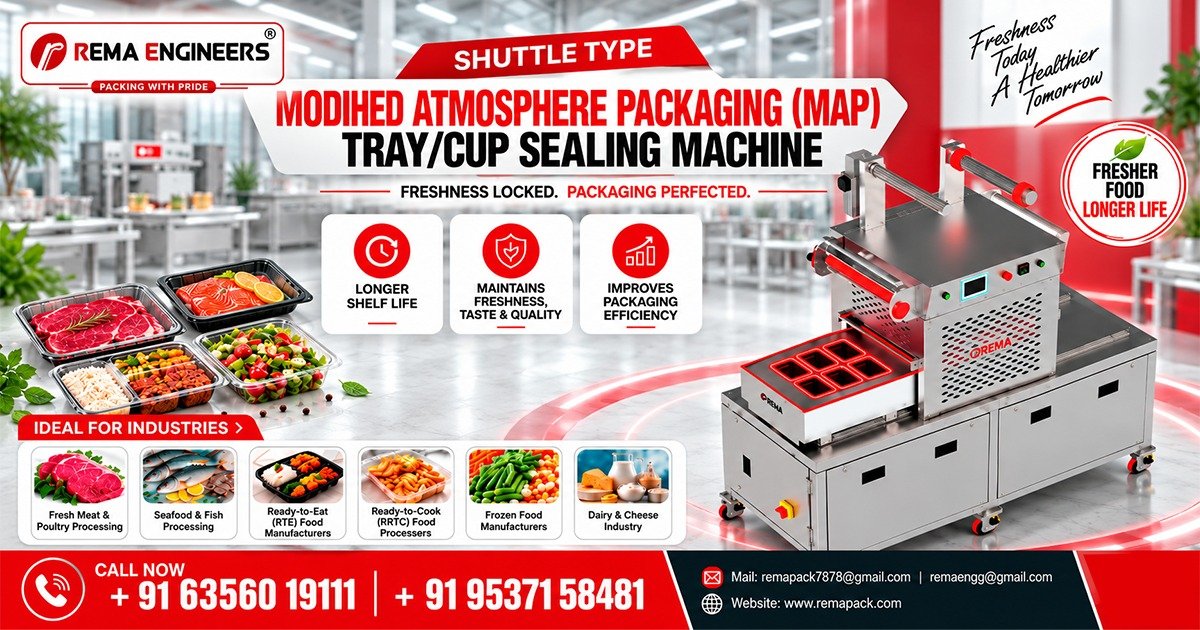
Rema Engineers Pvt. Ltd. Pvt. Ltd. manufactures and supplies packaging machinery including rotary, linear, shuttle, and semi-automatic MAP tray/cup sealing systems. Its published product information specifically includes a rotary semi-automatic MAP machine using vacuum and gas technology.
For buyers evaluating a Rotary MAP (Vacuum+Gas) Tray Sealing Machine In Bihar, the discussion with Rema Engineers Pvt. Ltd. can focus on the actual product, tray dimensions, film requirements, mould arrangement, process sequence, utilities, and installation conditions.
The company states that its manufacturing base is in Ahmedabad, Gujarat, with factory units in Odhav and Vatva. This manufacturing support location can be relevant when coordinating equipment requirements, fabrication, project communication, and supply planning for a Bihar installation.
Rather than treating the machine as a standalone purchase, buyers should approach the manufacturer with a complete packaging requirement. That makes it easier to determine whether the selected configuration is technically and operationally appropriate.
FAQs
1. What information should I send a manufacturer before requesting a quotation?
Share the product type, tray dimensions, tray height, film details, required packaging process, production expectations, available utilities, automation preference, and installation-space information.
2. Can the tray mould be matched to a specific package format?
The mould arrangement should be discussed with the manufacturer before ordering. Rema Engineers Pvt. Ltd. states that its rotary MAP equipment can accommodate customized tray-related configurations, subject to the selected machine and requirement.
3. Does MAP tray sealing require both vacuum and gas flushing?
Not every tray-sealing application requires the same process. Where modified-atmosphere packaging is required, vacuum evacuation and gas flushing can form part of the packaging cycle; the appropriate process should be determined from the product and packaging requirements.
4. What should Bihar buyers check before installation?
Confirm machine access, floor space, electrical supply, compressed-air requirements where applicable, product flow, operator access, mould arrangements, cleaning space, and maintenance access before the equipment reaches the plant.
Conclusion
Selecting tray-sealing equipment should begin with the packaging requirement rather than a machine name. For Bihar projects, buyers should match the product, tray, film, process, utilities, plant layout, and support expectations before placing an order. Early coordination with the manufacturer can reduce avoidable installation and operating issues.
Have a tray-packaging requirement in Bihar? Discuss your product, tray format, production workflow, and plant conditions with Rema Engineers Pvt. Ltd. Pvt. Ltd. to identify a suitable machine configuration.
Call Us: +91-63560-19111 +91-95371-58481
Email: remapack7878@gmail.com | remaengg@gmail.com
Website: www.remapack.com
View Product: Click here