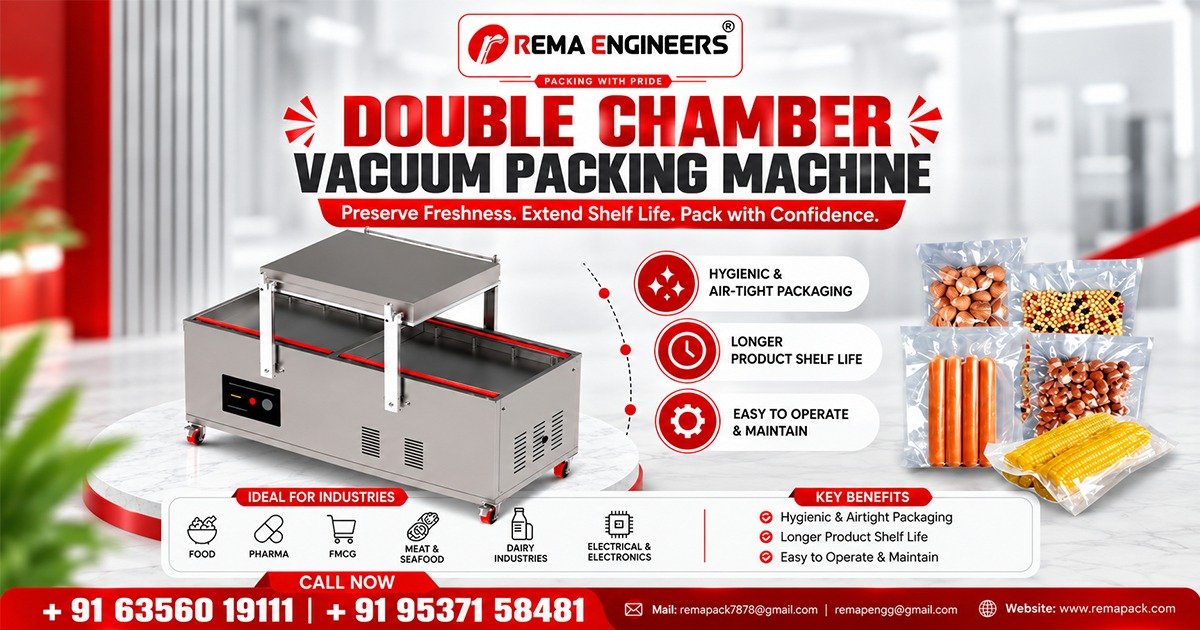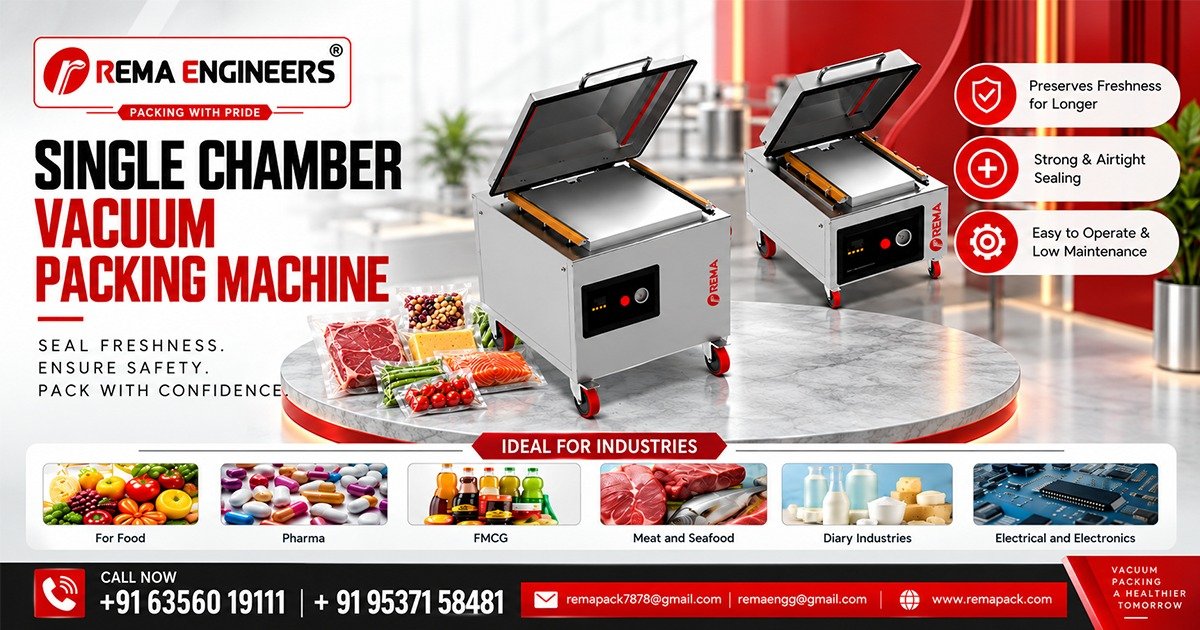




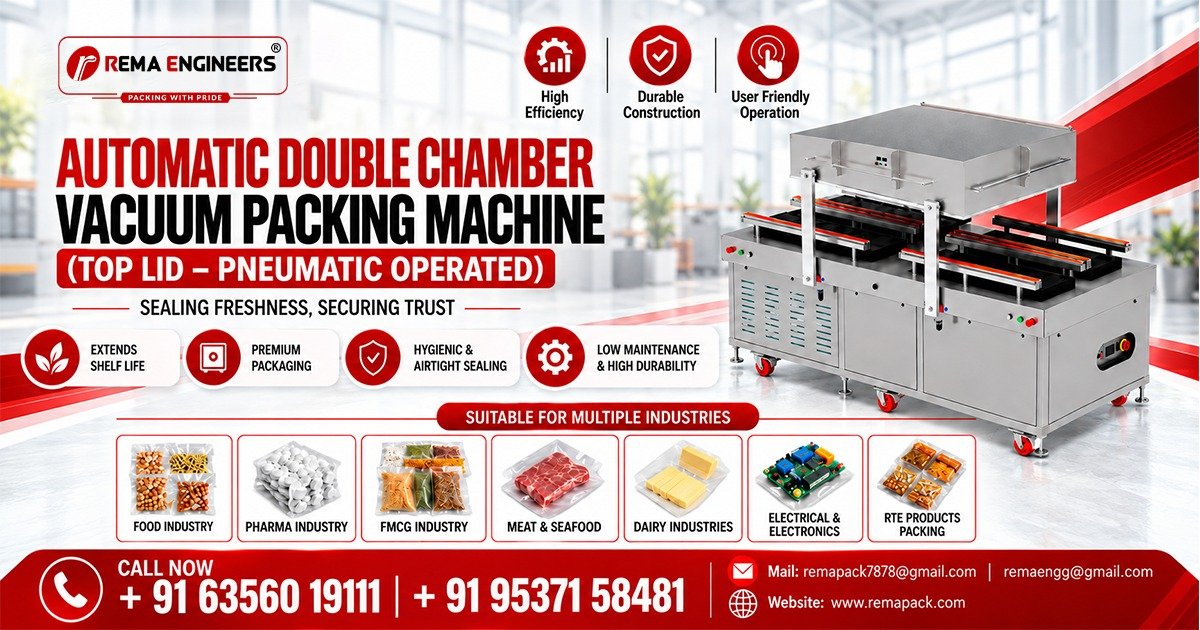
Rema Engineers Pvt. Ltd. Pvt. Ltd. supports packaging requirements for Australian businesses seeking an automatic double chamber vacuum packing machine to manage air removal, sealing consistency, and production flow, with manufacturing support from Ahmedabad, Gujarat, India.
How Double Chamber Vacuum Packing Supports Continuous Packaging Work
Vacuum packaging helps remove air from a package before sealing, supporting product protection and storage requirements. A double chamber machine provides two chambers that can be used alternately, allowing operators to prepare the next batch while the previous cycle is being completed, depending on the machine configuration.
For Australian food processors, packaging companies, and industrial buyers, this arrangement can help manage repetitive packaging work without relying on a single chamber for every stage.
The equipment may be considered for:
– Food products requiring reduced-air packaging.
– Processed or prepared products packed in suitable vacuum-compatible pouches.
– Businesses handling repeated packaging batches.
– Packaging operations where sealing consistency and workflow coordination matter.
The suitability of a machine depends on the product, packaging material, required output, and operating environment.
What Australian Buyers Should Check Before Selecting a Machine
An automatic double chamber vacuum packing machine in Australia should be selected according to actual production conditions rather than purchase price alone.
Before requesting a quotation, buyers should clarify these requirements:
– Product dimensions: Confirm the maximum product size and the space needed inside the chamber.
– Production volume: Estimate the number of packs required per shift and the expected operating hours.
– Packaging material: Check pouch compatibility, thickness, sealing requirements, and product characteristics.
– Vacuum requirements: Discuss the appropriate vacuum level and cycle settings for the product.
– Automation level: Confirm which operations are automatic and which require operator involvement.
– Available floor space: Allow room for loading, unloading, cleaning, and routine servicing.
These details help suppliers recommend an appropriate configuration without relying on assumptions about the buyer’s production needs.
Understanding the Machine’s Operating Sequence
A double chamber vacuum packing system follows a sequence of loading, air removal, sealing, and unloading. The precise operating method varies according to the equipment design and automation level.
Step 1 – Prepare the product
Place the product inside a suitable vacuum-compatible pouch and arrange it so the sealing area remains clean.
Step 2 – Load the chamber
Position the pouch correctly inside the chamber and check that the product does not obstruct the sealing area.
Step 3 – Remove air and seal
The machine removes air from the chamber and seals the pouch according to the configured cycle.
Step 4 – Complete the cycle
The chamber returns to its unloading condition, allowing the packaged product to be removed.
Step 5 – Continue the next batch
Where the machine design permits alternate chamber operation, the operator can prepare another batch while the previous chamber completes its cycle.
Actual throughput depends on product size, pouch dimensions, cycle settings, loading time, and operator workflow.
Installation Planning for Australian Facilities
Installation planning should be completed before the equipment is dispatched. Australian buyers should confirm the site’s electrical supply, available space, access routes, and operating requirements with the supplier.
Review the following points before installation:
– Electrical compatibility: Verify the required voltage, frequency, phase, and electrical protection against the machine’s documentation.
– Machine positioning: Provide adequate clearance for chamber movement, product handling, and maintenance access.
– Floor conditions: Confirm that the proposed location can support the equipment safely.
– Production layout: Keep incoming products, packaging materials, and finished packs organised around the machine.
– Commissioning: Arrange appropriate operating checks and trial packaging before routine production begins.
For imported equipment, also confirm shipping arrangements, import documentation, local electrical requirements, and the availability of technical assistance.
Preventing Packaging Defects Through Routine Checks
Packaging problems may result from unsuitable pouches, product contamination near the seal, incorrect cycle settings, worn sealing components, or inconsistent loading practices.
A simple inspection routine can help identify problems before they affect a large batch.
| Common issue | Possible cause | Practical check |
| Incomplete seal | Contaminated sealing area or unsuitable settings | Inspect pouch edges and verify approved cycle settings |
| Air remaining in the pack | Incorrect loading or unsuitable cycle conditions | Review pouch placement and vacuum settings |
| Wrinkled sealing area | Uneven pouch positioning | Arrange the pouch flat before starting the cycle |
| Inconsistent results | Variation in product loading or packaging materials | Standardise loading practices and inspect consumables |
| Machine stops unexpectedly | Electrical or control-related fault | Follow the operating manual and contact qualified service personnel |
Operators should follow the manufacturer’s maintenance instructions. Electrical repairs and internal machine servicing should be performed by qualified personnel with the equipment safely isolated.
Quality Checks That Matter Before Placing an Order
A supplier quotation should describe the proposed machine clearly enough for the buyer to compare it with other options.
Ask for confirmation of:
– Chamber dimensions and suitable product sizes.
– Sealing arrangement and compatible packaging materials.
– Vacuum system configuration and operating controls.
– Electrical requirements and machine documentation.
– Inspection and functional testing arrangements.
– Recommended maintenance procedures and replacement parts.
– Warranty terms, delivery scope, and technical support arrangements.
Buyers should also request a demonstration or product trial where practical. Testing representative products and pouches can help establish whether the proposed equipment matches the intended packaging process.
Planning Packaging Requirements With Rema Engineers Pvt. Ltd. Pvt. Ltd.
Rema Engineers Pvt. Ltd. Pvt. Ltd. provides a point of contact for businesses evaluating packaging machinery for their production requirements. Its website, remapack.com, can be used to explore the company’s packaging equipment information and discuss the appropriate machine configuration.
The company has manufacturing support from Ahmedabad, Gujarat, India. Australian buyers should confirm the exact machine specifications, export arrangements, installation responsibilities, spare-part availability, and after-sales support before finalising an order.
Providing sample product details, pouch dimensions, expected production volume, and site requirements can make the technical discussion more productive.
Services
– Packaging requirement assessment and machine selection consultation.
– Configuration review based on product dimensions and production workflow.
– Pre-dispatch technical coordination and installation planning.
– Maintenance guidance and spare-part requirement discussions.
Location
Australian businesses assessing vacuum packaging equipment can evaluate their requirements across Sydney, Melbourne, Brisbane, Perth, Adelaide, Canberra, Hobart, Darwin, Gold Coast, Newcastle, Wollongong, Geelong, Townsville, Cairns, Toowoomba, Ballarat, Bendigo, Launceston, Mackay, Rockhampton, Sunshine Coast, Albury, Bunbury, Wagga Wagga, and Port Macquarie. Product suitability, shipping arrangements, and technical support should be confirmed for the buyer’s specific location.
Frequently Asked Questions
Q: What should I consider when buying an automatic double chamber vacuum packing machine in Australia?
A: Compare chamber dimensions, production requirements, pouch compatibility, vacuum settings, electrical specifications, maintenance access, and supplier support. Confirm the machine’s suitability for your actual product before ordering.
Q: Can a double chamber vacuum packing machine handle different product sizes?
A: This depends on the chamber dimensions, sealing arrangement, and product characteristics. Discuss the largest and smallest products you intend to pack with the supplier.
Q: What electrical details should Australian buyers verify?
A: Confirm the machine’s voltage, frequency, phase, power requirements, and electrical protection. Ensure these match the intended installation site and applicable local requirements.
Q: How can packaging quality be maintained over time?
A: Keep sealing areas clean, use compatible pouches, follow recommended operating settings, inspect wear components, and carry out preventive maintenance according to the manufacturer’s instructions.
Conclusion
Selecting vacuum packaging equipment for Australian production requires careful assessment of pack dimensions, output requirements, sealing quality, and installation conditions. Rema Engineers Pvt. Ltd. Pvt. Ltd. offers manufacturing support from Ahmedabad, Gujarat, India, for buyers discussing suitable machinery configurations and project requirements.
Contact Rema Engineers Pvt. Ltd. Pvt. Ltd. through remapack.com to discuss your packaging requirements, review machine suitability, and clarify technical specifications, export arrangements, and support needs for your Australian facility.
Call Us: +91-63560-19111 +91-95371-58481
Email: remapack7878@gmail.com | remaengg@gmail.com
Website: www.remapack.com
View Product: Click here