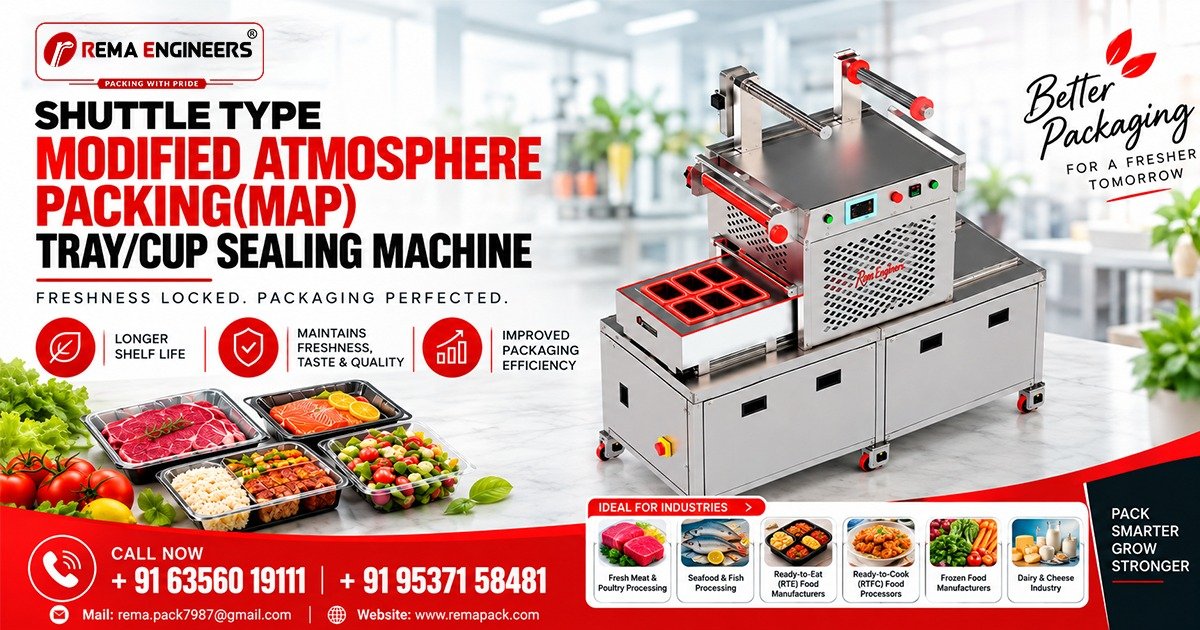




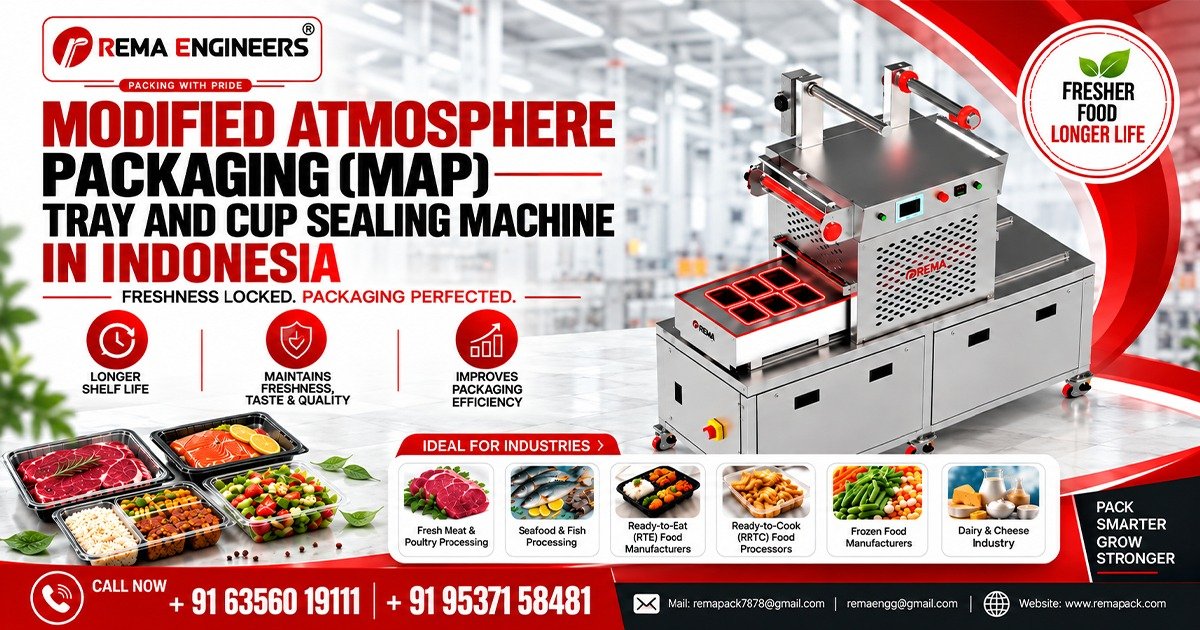
Food packaging businesses in Indonesia must balance product freshness, seal quality, and production requirements. A Modified Atmosphere Packaging (MAP) Tray and Cup Sealing Machine In Indonesia can support controlled-atmosphere packaging processes when selected for the product and packaging format.
How MAP Packaging Fits Into Food Production
Modified Atmosphere Packaging (MAP) involves changing the atmosphere inside a package, commonly by replacing some of the existing air with a selected gas mixture before sealing. The aim is to help manage product freshness and quality during storage and distribution.
For food processors in Indonesia, MAP tray and cup sealing equipment may be considered for products such as:
- Fresh and processed meat
- Seafood and prepared food
- Ready-to-eat meals
- Dairy products
- Fresh-cut vegetables
- Selected food products packed in cups or trays
The appropriate gas mixture, packaging film, and storage conditions depend on the food being packed. MAP does not replace hygienic handling, temperature control, or a suitable shelf-life validation process.
What Buyers Should Decide Before Selecting a Machine
The packaging format and production target should guide the machine selection. A machine intended for one tray size may not suit another product without the appropriate tooling or configuration.
Review these requirements before requesting a quotation:
- Pack dimensions: Confirm tray or cup length, width, depth, and rim design.
- Production demand: Estimate the number of packs required per shift and the expected peak output.
- Product characteristics: Consider moisture, temperature, food structure, and sensitivity to the selected gas mixture.
- Packaging material: Verify compatibility between the container, lidding film, and sealing process.
- Automation level: Determine whether manual loading, assisted operation, or an automated production arrangement fits the plant.
- Future requirements: Consider whether additional pack formats or product varieties may be introduced later.
These details help buyers compare suitable configurations instead of evaluating machines on purchase price alone.
Understanding the Tray and Cup Sealing Process
A MAP packaging cycle generally follows a sequence of preparation, loading, atmosphere control, sealing, and inspection. The exact arrangement depends on the machine design.
- Product preparation: Food is prepared and portioned according to the packaging specification.
- Container loading: Filled trays or cups are positioned correctly in the machine.
- Atmosphere modification: The machine removes or displaces the existing atmosphere and introduces the specified gas mixture, where supported by the selected configuration.
- Film sealing: Compatible lidding film is sealed to the container rim under the required operating conditions.
- Pack inspection: Operators check seal integrity, film placement, leakage, and other defined quality parameters.
Gas composition, residual oxygen, sealing temperature, pressure, and cycle settings should be established through product-specific trials and validated operating procedures.
Installation Planning for Indonesian Food Processing Facilities
Installation planning should begin before the equipment reaches the plant. Available floor space, operator access, material movement, electrical supply, and the surrounding packaging line can all affect the installation.
Buyers should confirm:
- The machine footprint and required operating clearances.
- Electrical specifications and any required utilities.
- Access for loading containers and removing sealed packs.
- Cleaning access around product-contact and packaging areas.
- Compatibility with upstream filling and downstream inspection or labelling equipment.
- Commissioning arrangements, operator training, and technical documentation.
For food-processing facilities, the installation plan should also support hygienic working practices and the site’s cleaning procedures.
Seal Quality and Common Operating Problems
Consistent packaging requires more than a correctly selected machine. Container condition, film compatibility, product contamination around the sealing rim, and process settings can affect the finished pack.
| Common issue | Possible cause | Practical check |
| Weak or uneven seals | Incorrect settings, worn components, or an uneven container rim | Check the approved sealing settings and inspect the rim and tooling |
| Film wrinkles | Incorrect film positioning or material mismatch | Verify film alignment and compatibility |
| Gas composition varies | Gas supply or process-control variation | Check the gas supply and verify the packaging process using suitable measurement equipment |
| Containers deform during sealing | Unsuitable process settings or container material | Review the container specification and validated settings |
| Frequent production interruptions | Incorrect loading, component wear, or operating inconsistencies | Review the operating procedure and maintenance records |
Operators should follow the manufacturer’s instructions for adjustments and servicing. Electrical, pneumatic, and other technical interventions should be performed by appropriately qualified personnel.
Quality Checks Before Approving the Equipment
A buyer should establish acceptance criteria before finalising an order. This reduces uncertainty during commissioning and helps the supplier understand the intended application.
Use this checklist during supplier discussions:
- Confirm the proposed machine’s suitability for the required tray and cup formats.
- Review sealing performance using representative containers and film.
- Verify the intended gas-flushing arrangement and available process controls.
- Request a product trial where feasible.
- Establish measurable criteria for seal integrity and residual gas levels, as applicable.
- Clarify the operating capacity under the proposed product and packaging conditions.
- Review cleaning procedures, maintenance access, and recommended spare parts.
- Confirm documentation, installation responsibilities, training, and after-sales support.
Acceptance testing should reflect the actual product, packaging material, and production conditions rather than relying solely on general equipment specifications.
Routine Maintenance and Production Continuity
Preventive maintenance helps identify wear and operating inconsistencies before they interrupt production. The maintenance schedule should follow the machine manufacturer’s recommendations and the plant’s operating conditions.
Daily operating checks may include film alignment, sealing-surface cleanliness, container positioning, and visible signs of wear. Scheduled maintenance may cover sealing tooling, moving components, electrical connections, and other parts identified in the manufacturer’s service documentation.
Keep records of recurring seal defects, rejected packs, downtime, and component replacement. These records can help the maintenance team identify patterns and plan spare-parts requirements.
Services
- Packaging requirement assessment and machine selection consultation.
- Tray and cup format evaluation for the intended production process.
- Installation planning and commissioning coordination.
- Technical guidance, operator training coordination, and after-sales support discussions.
Location
Indonesia’s food processing and packaging industry serves a wide range of domestic and export-oriented markets. Businesses evaluating MAP packaging equipment may operate in Jakarta, Surabaya, Bandung, Semarang, Yogyakarta, Medan, Makassar, Denpasar, Palembang, Pekanbaru, Batam, Balikpapan, Samarinda, Banjarmasin, Manado, Malang, Solo, Cirebon, Tangerang, Bekasi, Karawang, Bogor, Sidoarjo, Gresik, and Pasuruan. The suitability of a machine depends on each facility’s product range, packaging requirements, production capacity, and available technical support.
Packaging Project Support From Rema Engineers Pvt. Ltd. Pvt. Ltd.
Rema Engineers Pvt. Ltd. Pvt. Ltd. provides packaging machinery solutions for businesses evaluating their production requirements. Buyers considering MAP tray and cup sealing equipment for Indonesia can discuss their intended product, container dimensions, packaging material, output targets, and automation preferences during the equipment selection process.
The company offers manufacturing support from Ahmedabad, Gujarat, India. For project discussions, product information, and equipment enquiries, visit Rema Engineers Pvt. Ltd. Pvt. Ltd..
Before finalising a purchase, Indonesian buyers should also clarify export documentation, shipping arrangements, commissioning responsibilities, spare-parts availability, and remote or on-site service options applicable to their project.
Frequently Asked Questions
Q: What products can be packed using a MAP tray and cup sealing machine?
A: Depending on the machine configuration, suitable products may include prepared meals, meat, seafood, dairy products, and selected fresh foods. Container compatibility and the packaging process must be verified for each product.
Q: How do I determine the required machine capacity?
A: Estimate the required packs per hour or shift, considering loading time, the number of containers per cycle, product handling, and expected downtime. Confirm achievable output with the supplier.
Q: Does MAP packaging guarantee a longer shelf life?
A: No. Shelf life depends on the food, gas mixture, packaging barrier properties, hygiene, sealing integrity, and storage temperature. Product-specific validation is necessary.
Q: What should Indonesian buyers confirm before importing the equipment?
A: Confirm machine specifications, electrical compatibility, shipping and import documentation, installation arrangements, operator training, spare parts, and the scope of technical support.
Conclusion
For food processors in Indonesia, MAP tray and cup sealing equipment should be selected around the product, container format, required output, and packaging quality criteria. Careful trials and installation planning help reduce purchasing uncertainty. Rema Engineers Pvt. Ltd. Pvt. Ltd. offers manufacturing support from Ahmedabad, Gujarat, India, for relevant packaging equipment enquiries.
Contact Rema Engineers Pvt. Ltd. Pvt. Ltd. through remapack.com to discuss your packaging requirements, evaluate suitable machine configurations, and plan your project for the Indonesian market.
Call Us: +91-63560-19111 +91-95371-58481
Email: remapack7878@gmail.com | remaengg@gmail.com
Website: www.remapack.com
View Product: Click here